
In elite golf, precision is everything. Margins are small. Feedback matters. Consistency is built over time. Yet when people talk about indoor golf, the conversation will often stop at technology. Launch monitors. Data points. Ball flight. Club delivery. The assumption is that if the technology is good enough, performance will naturally follow. In reality, technology on its own is never the complete answer.
Real performance is created when precision is supported by an environment designed for accuracy, repeatability, and focus. And without that, even the most advanced technology can’t deliver miracles. This is where many indoor golf experiences fall short and where the real difference between installation and performance begins.
Precision matters because golf is a game of fine margins. A fraction of a degree in clubface angle, a few miles per hour of clubhead speed, a subtle change in strike location. These things add up really quickly.
When feedback is clear and consistent, golfers can make sense of what’s happening and why. Confidence builds. Adjustments become intentional rather than reactive. Over time, that’s how we earn consistency.
That said, precision is fragile. It relies on repeatability and trust. If conditions change, feedback feels unreliable, or the environment introduces distractions, progress will slow. Golfers start second-guessing outcomes instead of refining technique.
This is why the setting matters as much as the data itself.
Launch monitor technology has played it part in transforming the modern game. Systems like Trackman are trusted because they provide accurate, dependable feedback. But even the best technology can only perform within the limits of its surroundings.
Lighting that creates glare. Screens that distort depth perception. Poor acoustics that disrupt rhythm. Restricted space that subtly alters movement. These factors don’t just affect comfort, they affect confidence.
When the environment introduces uncertainty, golfers stop trusting the feedback. And once trust is lost, practice becomes less effective.
Precision needs more than sensors and software. It needs an environment that supports what the technology is trying to do.
At the highest level of the game, nothing is left to chance. Professional training environments are designed around how golfers actually practise.
They remove unnecessary variables. They create consistent visual references. They allow players to return to the same setup session after session.
Not because it looks impressive, but because it works.
Elite environments are built to encourage focus. They reduce friction. They make repetition easier and learning faster.
That approach isn’t exclusive to professionals. The same principles apply wherever meaningful improvement is the goal.
There’s an important distinction between installing equipment and creating a performance environment.
Installing equipment answers the question, “What technology should we use?”
Creating an environment asks, “How will this space actually be used?”
The second question changes everything.
It shapes decisions around layout, lighting, acoustics, materials, and flow. It considers comfort, usability, and how inviting the space feels over time. It recognises that performance improves when people genuinely want to return to the space.
That difference is subtle, but it’s where long-term value is created.
Improvement in golf doesn’t come from hitting more balls. It comes from hitting better balls with intention.
Repeatability is what allows that to happen. When conditions stay consistent, golfers can:
• Isolate variables
• Test adjustments
• Build trust in the outcome.
Progress becomes visible rather than guessed.
Well-designed indoor environments remove uncertainty. The same setup, sightlines, and feedback - Every time.
That consistency builds confidence, and confidence is what turns practice into performance.
Design is often seen as a visual consideration. In performance environments, it’s functional.
Good design influences how relaxed a player feels, how long they stay in the space, and how often they return. It shapes mood, focus, and willingness to practise.
A space that feels permanent and intentional encourages regular use. One that feels improvised or clinical often doesn’t.
This matters for homes and venues alike. People return to spaces that feel good to be in.
Recently, this approach has come to life at Stonham Barns Golf Park, where a new Trackman Lux Bay has been carefully integrated into an existing venue. Not as a bolt-on, but as a considered extension of their offering. If you haven’t seen what they offer yet, we highly recommend you take a look, because as a whole-family venue it certainly fits the bill!
Rather than treating the technology as a bolt-on, the environment around it was designed to support accuracy, comfort, and repeatability. The result is a space that feels integrated, purposeful, and easy to use.
It’s a reminder that performance improves when technology is given the right setting to operate within.
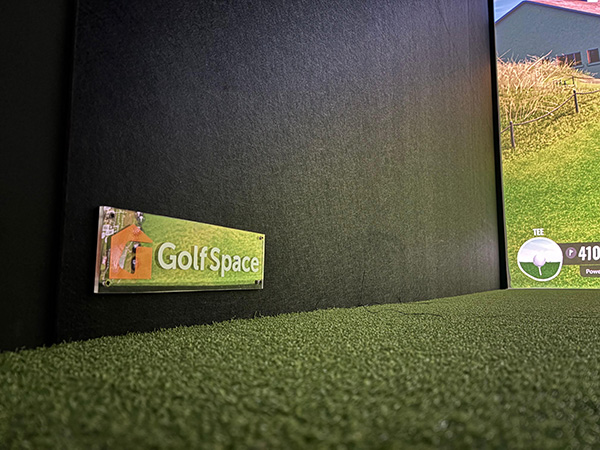
The GolfSpace Standard
Every GolfSpace is delivered to a single benchmark: the GolfSpace Standard.
It’s shaped by four values:
• Excellence
• Integrity
• Craftsmanship
• Innovation.
From first sketch to first tee shot, every decision is made with performance and usability in mind. Lighting, acoustics, materials, cabinetry, and technology integration are considered as a whole, not in isolation.
The aim is simple. To create spaces that feel effortless to use and precise in performance.
For homeowners, a purpose-built GolfSpace removes friction. Weather, daylight, and time constraints fall away. Practice becomes easier to fit into everyday life, and enjoyment increases as a result.
For venues, the same principles create experiences guests trust and return to. A well-designed performance environment becomes part of the venue’s identity, not just another feature.
In both cases, precision isn’t something you switch on. It’s something you design for.
Technology has changed golf. But performance still depends on the conditions that surround it.
When data, environment, and experience work together, improvement becomes more consistent, confidence grows, and progress follows naturally.
That’s the thinking behind GolfSpace.
Because when precision matters, the space matters too.