
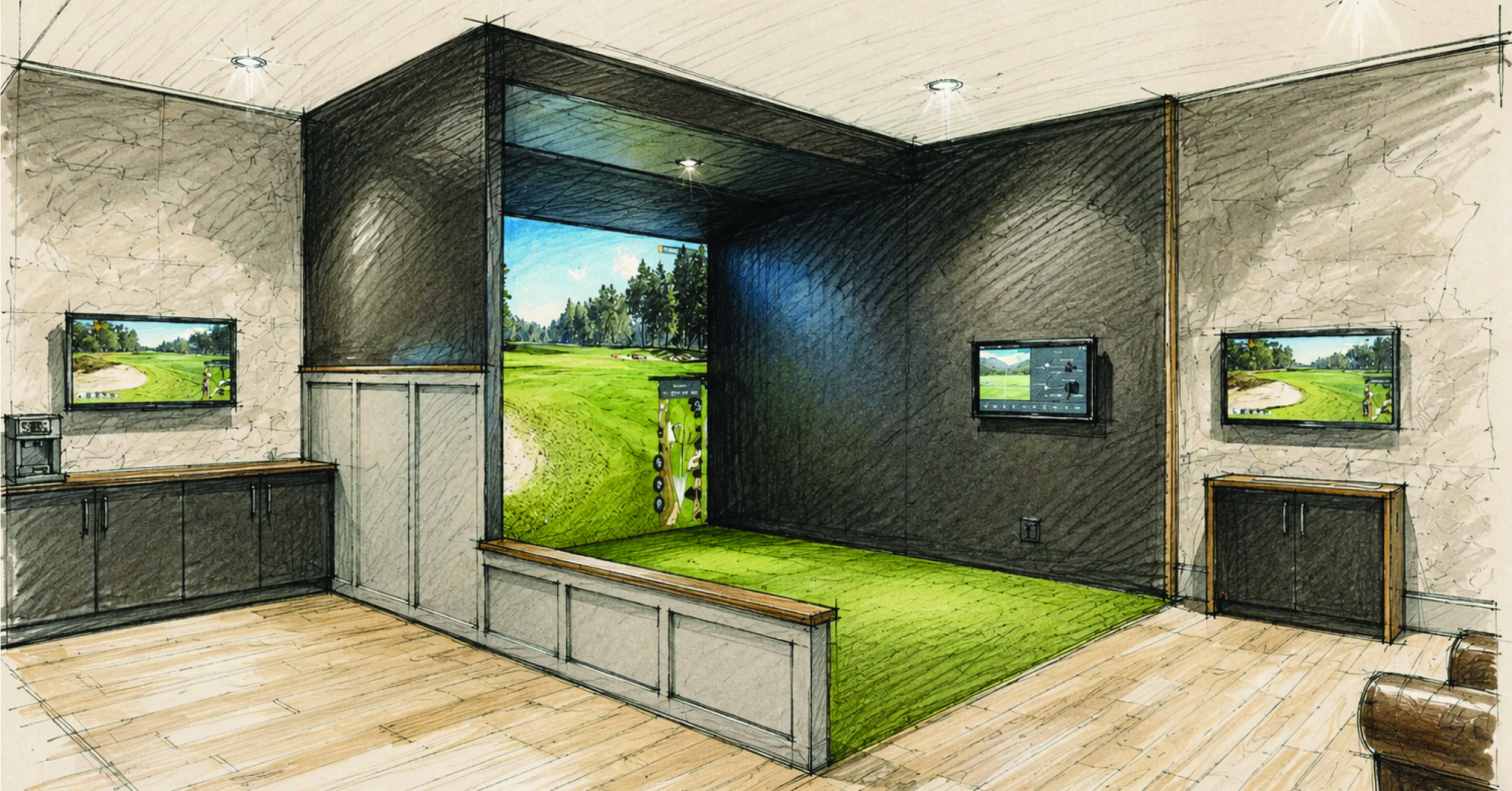
The most successful GolfSpaces don’t begin with a simulator. They begin with a conversation. Before layouts, technology, or finishes are discussed, the early stages of a GolfSpace project are about understanding how the space will actually fit into everyday life. The property. The ambitions for the room. How it will be used. And what kind of experience the client wants to create long term. In this article, we explore why the earliest conversations often shape the success of the entire project.
It’s easy to assume that designing a GolfSpace starts with technology.
Trackman model.
Screen size.
Software.
Features.
And while those things absolutely matter, they’re rarely where the best projects begin.
The strongest GolfSpaces usually start much earlier, with a conversation about the individual(s), the property, and how the space is actually going to be used.
Because before anything is designed, there needs to be a clear understanding of what the environment needs to deliver.
At GolfSpace, the first stage of a project is never about selling a product.
It’s about understanding whether the vision, the property, and the possibilities all align in the right way. That early scoping stage allows conversations around:
- How the client lives day to day
- Whether the space is focused on performance, entertaining, or both
- How the GolfSpace should connect with the wider home
- What level of realism or immersion is important
- How often the space is likely to be used
- Whether future technologies or integrations should be considered early
These aren’t just design questions. They shape the entire direction of the project.
Every property introduces different opportunities and constraints.
A new-build garden room creates different possibilities to a listed property conversion. A basement environment behaves differently to a loft or garage. Ceiling height, structure, natural light, flooring depth, access, acoustics, and room proportions all influence what the space can become.
The earlier those factors are understood, the better the eventual outcome tends to be.
This is also why GolfSpace projects are approached collaboratively from the beginning. The goal isn’t simply to ‘make a simulator fit’. It’s to create an environment that feels natural, considered, and genuinely enjoyable to use over time.
And increasingly, those early discussions also involve future-facing decisions around technology integration. More advanced systems, including dynamic flooring technologies such as Zen Golf’s Swing Stage, need to be considered at design stage rather than added retrospectively later.
Planning for these possibilities early creates far moreflexibility in what the GolfSpace can ultimately support long term.
One of the things that becomes clear very early in the process is that no two GolfSpaces are really the same.
For some clients, the priority is structured practice and measurable improvement. For others, it’s about creating a space to entertain, relax, or spend time with family and friends. Often, it’s a balance of all of them.
That’s why understanding lifestyle matters just as much as understanding the golf itself.
The most successful GolfSpaces are rarely single-purpose rooms. They’re spaces designed to fit naturally into everyday life, while still delivering exceptional performance when it matters.
As more people invest in how they use their homes overall, indoor golf is increasingly becoming part of a wider lifestyle environment, rather than a standalone feature.
The projects that feel the most seamless at the end are usually the ones where the early conversations happened properly.
Not because the process becomes more complicated, but because the right decisions are made earlier.
- Lighting is planned before electrics are fixed.
- Floor structures are considered before finishes are chosen.
- Room layouts support both movement and atmosphere.
- Future integrations are factored in before compromises appear later.
Those decisions have a direct impact on how naturally the GolfSpace works once it’s complete.
It’s often the subtle details that influence whether a space becomes part of someone’s regular routine, or something that gets used occasionally.
When the environment has been considered properly from the outset, everything tends to work together more naturally. The technology performs better. The space feels more immersive. And the overall experience becomes easier to return to consistently.
The most impressive GolfSpaces aren’t always the ones with the most visible technology. They’re usually the ones that feel effortless to use.
- Spaces where the lighting feels right.
- Where the proportions feel comfortable.
- Where the environment connects naturally with the rest of the home.
- Where practice, entertainment, and everyday life can all exist comfortably together.
That’s ultimately what turns a normal simulator room into a GolfSpace.
Not just how it looks on day one, but how naturally it fits into everyday life over time.
Every GolfSpace starts differently, but the best projects tend to begin in the same way: With an open conversation about what the client actually wants the space to become.
Because creating a great GolfSpace isn’t about choosing a simulator. It’s about designing an environment people genuinely want to spend time in.
Start the conversation about your GolfSpace vision.