
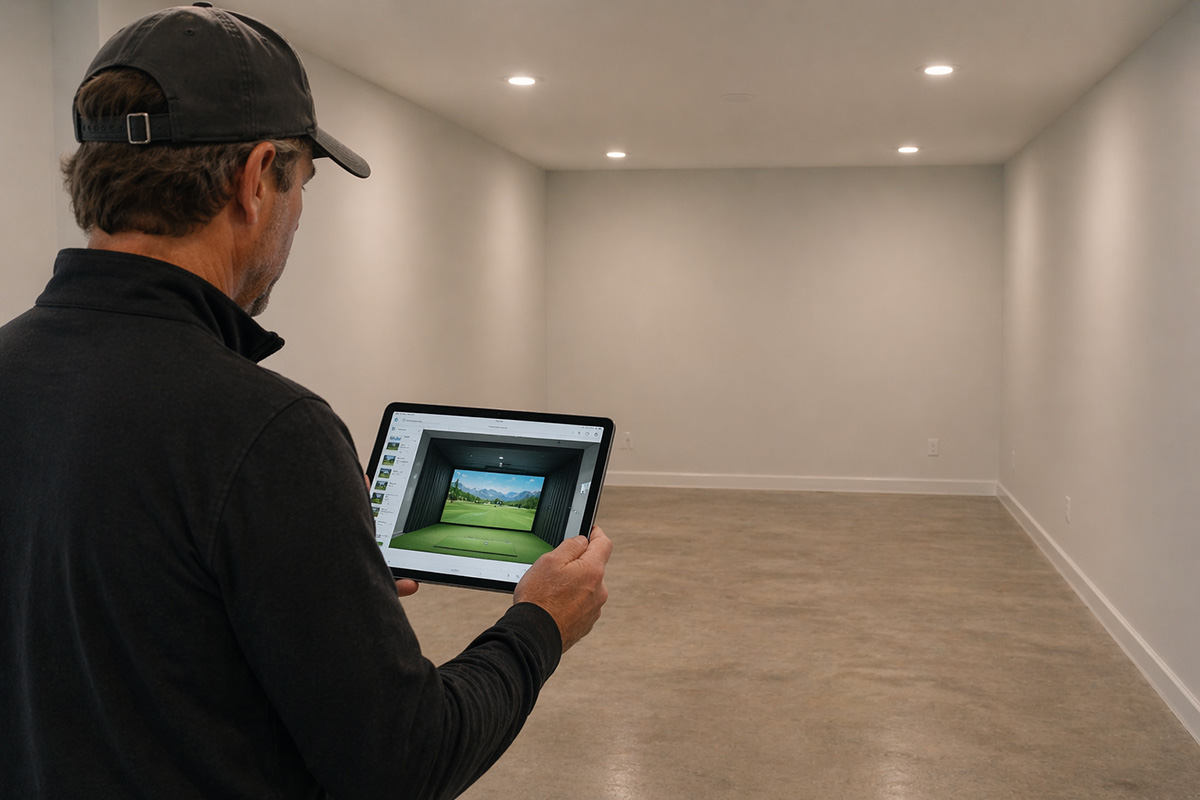
Designing a GolfSpace doesn’t start with the simulator. It starts with the space. From room proportions and ceiling height to lighting, structure, and flooring, the decisions made early in the process shape how well everything performs. Get them right, and the technology delivers exactly as it should. Get them wrong, and compromises tend to follow. In this article, we explore why planning ahead makes all the difference, and what to consider before the build begins.
It’s easy to assume that designing a GolfSpace starts with the technology.
- Which launch monitor to choose.
- What screen size works best.
- How the software you’ll use.
All important decisions, of course. But the most successful indoor golf simulator spaces don’t start there. They start much earlier, with the space itself.
Because when it comes to indoor golf, what you plan at the beginning determines what’s possible at the end.
Many projects begin with a fixed room.
A garage.
A spare room.
A new garden building.
A loft space.
The natural question becomes: “how do we fit a simulator into this space?”
But the more important question is: “what does this space need to deliver?”
That shift in thinking changes everything.
It moves the project from installation to design. From compromise to intention. And ultimately, from something that works on paper to something that performs in practice.
Before any technology is installed, there are a number of physical considerations that shape how well an indoor golf space performs.
Room dimensions and proportions
It’s not just about having enough space, it’s about having the right space. Room width, depth, and proportions all influence how comfortably and naturally you can swing, and how immersive the environment feels.
Ceiling height
One of the most common constraints. Ceiling height directly affects swing freedom, shot confidence, and long-term usability. What feels ‘just about workable’ at design stage can become restrictive over time.
Ball flight and clearance
Understanding how the ball travels within the space is critical. Clearance distances, impact positioning, and screen placement all need to be carefully planned to ensure both safety and realism.
Lighting and visibility
Lighting isn’t just aesthetic. It affects both performance and technology accuracy.
Natural light, fixed electrics, and lighting positions need to be considered early. Left unresolved, they can introduce glare and limit how well the space works.
Acoustics and feel
Often overlooked, but hugely important. Sound, echo, and material choices all affect how the space feels to use. Subtle details that, over time, influence whether the space is somewhere you want to spend time.
Individually, none of these decisions feel defining. Together, they shape the entire experience.
Flooring has evolved significantly in recent years. It was often treated as a finishing detail. Something chosen once the core elements of the simulator were in place.
That’s no longer the case.
Increasingly, flooring is becoming an integral part of the performance environment itself. From stability and strike consistency to comfort underfoot and long-term durability, the floor plays a more active role than many expect.
And with the introduction of more advanced systems, it’s also becoming a platform for enhancing realism.
As indoor golf continues to evolve, new technologies are changing what’s possible within a GolfSpace.
Dynamic flooring systems, such as Zen Golf’s Swing Stage, can introduce variable lies and subtle terrain changes, allowing golfers to practise in conditions that more closely reflect the course.
These kinds of features add depth to practice. They introduce variability, challenge, and realism that go beyond flat, repeatable shots.
But they also introduce a new requirement. They need to be planned for.
- Floor depth.
- Structural allowances.
- Integration with surrounding finishes.
- Clearances and positioning.
These are not elements that can always be easily adjusted once the space is built.
Which means decisions made early in the process have a direct impact on what the GolfSpace can support over time.
As Ben Magor, Project Delivery Director at GolfSpace, notes:
“The best results always come from the projects where we’re involved early. It allows us to look at the space as a whole, proportions, structure, materials, and how everything needs to work together.
When those decisions are made upfront, the build becomes more precise, the integration is cleaner, and the finished space performs exactly as it should. It’s not about adding complexity, it’s about making sure every element supports the end result.”
That early involvement isn’t to add complexity. It’s to remove it.
By resolving key decisions at design stage, the build becomes more efficient, the integration more seamless, and the end result more aligned with how the space will actually be used.
The most effective GolfSpaces are designed around use, not just installation.
- Will it be used for focused practice?
- For socialising and entertaining?
- For family time?
- For year-round play regardless of weather?
Often, it’s all of these.
Planning early allows those use cases to be designed into the space, rather than adapted to it later.
And that’s what ultimately determines whether a GolfSpace becomes part of everyday life, or something used occasionally.
For us, it always starts with the space. Technology is then integrated in a way that supports how it’s designed to be used.
From initial concept through to final installation, each decision is made with performance, usability, and long-term value in mind.
This is because the goal isn’t just to install a simulator. It’s to create an environment that works exactly as it should, from the very first swing.
If you're considering a GolfSpace for your home or venue, the earlier these conversations happen, the more we can shape what’s possible.
Get in touch and start planning your GolfSpace the right way.